




Cart 0
Common Causes of Pallet Racking Damage
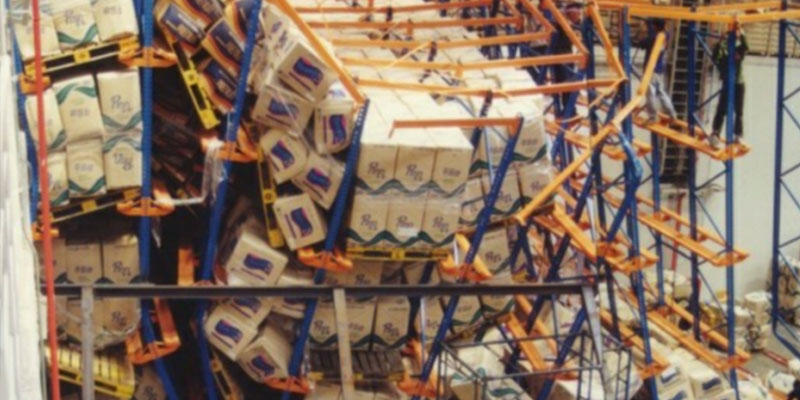
Pallet racking damage should never be dismissed as a cosmetic problem. A bent upright, displaced beam or loose fixing can reduce the strength and stability of a storage system, particularly when the affected rack continues to carry heavy loads.
Some forms of rack damage are immediately visible. Others may be concealed behind stored goods or appear insignificant to somebody who has not been trained to assess racking. If damaged warehouse racking remains in use, further impacts or loading could make the problem progressively worse.
Employees should therefore know how to report damage promptly, while the racking system should be checked and inspected at intervals appropriate to its use and level of risk. If you are concerned about the condition of your storage system, CAM can provide a professional racking inspection.
What Are the Main Warehouse Racking Failure Causes?
Racking rarely becomes damaged without an underlying cause. Identifying that cause is important because simply replacing a component will not prevent the same problem from happening again.
Common warehouse racking failure causes include vehicle impact, overloading, unsuitable pallets, unauthorised alterations, poor installation and deterioration over time.
1. Forklift and Materials-Handling Equipment Impacts
Contact with forklift trucks, reach trucks and other materials-handling equipment is one of the most common causes of pallet racking damage.
The lower sections of uprights are particularly exposed because trucks regularly travel and turn close to them. Damage may occur when a driver:
- Turns into an aisle too sharply
- Enters or removes a pallet incorrectly
- Travels with a raised or unstable load
- Misjudges the truck or load dimensions
- Operates in an aisle that is too narrow
- Has restricted visibility
- Uses unsuitable handling equipment
Even a relatively low-speed impact can bend an upright, damage bracing or affect the fixings connecting the rack to the floor. Drivers should report every collision, even when no obvious damage can be seen.
Adequate forklift driver training, clearly marked routes, good lighting and appropriately positioned rack protection can all help reduce the risk of repeated impacts.
2. Overloading the Pallet Racking
Every racking system has a defined load capacity based on its design, configuration and components. Loading it beyond that capacity can cause beams to deflect, connectors to become overstressed and the structure to become unstable.
Overloading may happen because:
- Individual pallets are heavier than expected
- Too many pallets are placed within a bay
- Heavier stock is moved to a level not designed for it
- Load notices are missing, damaged or out of date
- Employees do not understand the stated capacity
Current load notices should be clearly displayed. Warehouse teams must also understand that the capacity applies to a particular rack configuration. Moving beam levels or altering the system can affect that capacity.
If your existing configuration no longer meets your operational requirements, CAM can assess the space and recommend suitable pallet racking services.
3. Poorly Positioned or Damaged Pallets
The condition and placement of a pallet can be just as important as its weight. A broken, unsuitable or badly positioned pallet may fail to sit correctly on the supporting beams.
Potential problems include:
- Split or missing pallet boards
- Loads extending too far beyond the pallet
- Pallets sitting unevenly across beams
- Unsuitable pallet dimensions
- Loose or unstable products
- Pallets pushed too far into the rack
Pallets and their loads should be checked before storage. Damaged pallets should be removed from service, and loads should be stable, secure and compatible with the racking system.
The HSE’s pallet safety guidance provides further advice about the selection, use and storage of pallets.
4. Unauthorised Changes to the Racking Configuration
Pallet racking is designed as a complete system. Moving beams, changing bay heights or removing structural components without suitable approval can alter how loads are transferred through the structure.
A seemingly minor change may reduce the rack’s capacity or leave it unsuitable for its current use. Risks can arise when:
- Beam levels are moved
- Bracing is removed
- Bays are extended
- Rack layouts are changed
- Heavier products are introduced
- Operational equipment changes
Proposed modifications should be assessed by the racking supplier, manufacturer or another suitably competent specialist. Load notices must also be updated when an approved alteration changes the system’s capacity or configuration.
Businesses planning to adapt or expand their storage should review the available warehouse racking systems before making changes.
5. Mixing Incompatible Racking Components
Components from different manufacturers may look similar, but that does not mean they are interchangeable. Uprights, beams, connectors, locks and bracing are designed to perform as part of a particular system.
Combining components without appropriate technical approval can create uncertain connections and invalidate the original design assumptions. Replacement parts should therefore be compatible with the existing system and installed in accordance with the relevant manufacturer’s instructions.
6. Missing or Damaged Safety Components
Small components can play an important role in preventing larger failures. Examples include beam locking devices, floor fixings, spacers, column guards and end-of-aisle protection.
Warning signs include:
- Missing beam locks
- Loose or absent floor anchors
- Damaged bracing
- Disconnected components
- Displaced beams
- Loose row spacers
- Damaged upright protectors
A missing safety component should not be ignored simply because the main upright or beam still appears intact. Arrange a racking inspection if you are unsure whether the system remains safe to use.
7. Poor Installation or Unsuitable Flooring
Pallet racking depends on correct assembly and a floor capable of supporting and anchoring the system.
Problems can develop if the rack is out of alignment, fixings are unsuitable, baseplates do not sit correctly or the floor is cracked or uneven. Settlement, corrosion or damage around an anchor point may also affect stability.
New racking should be installed by competent personnel in accordance with the approved design and manufacturer’s instructions. It should also be checked after installation and before being fully brought into use.
CAM provides complete pallet racking services, including design, supply, installation and ongoing inspections.
8. Corrosion, Wear and Environmental Conditions
Not all racking damage results from a collision. Moisture, chemicals, cold-store conditions and outdoor exposure can cause corrosion or deterioration over time.
Paint loss may expose the steel beneath, while significant corrosion can reduce a component’s effective thickness. Rust around baseplates, fixings or welded connections deserves particular attention.
The inspection frequency should reflect the environment. Racking exposed to demanding or corrosive conditions may require more frequent assessment.
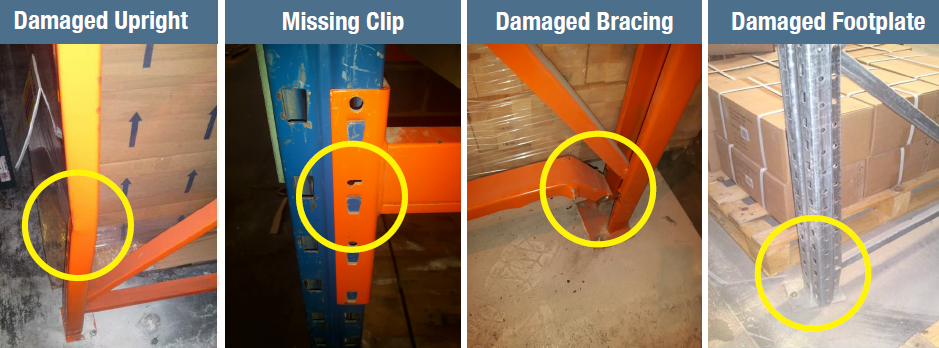
What Does Damaged Pallet Racking Look Like?
Employees should be encouraged to look for obvious warning signs during their normal work. These can include:
- Bent or twisted uprights
- Dents, buckling or splits in structural components
- Damaged horizontal or diagonal bracing
- Beams that appear distorted or excessively deflected
- Displaced beams or missing locking devices
- Cracked welds
- Loose or missing floor fixings
- Damaged baseplates
- Corrosion
- Leaning or misaligned bays
- Damaged mesh decks or pallet supports
- Pallets or loads no longer sitting correctly
It is important not to rely solely on appearance. The seriousness of damaged pallet racking should be determined by someone with the necessary knowledge and competence to assess the system.
If any of these signs are present, arrange a professional racking inspection before the damage is allowed to worsen.
What Should You Do After a Rack Impact?
If a forklift or load strikes the racking, the incident should be reported immediately. Staff should not wait for the next scheduled inspection.
The area should be made safe and protected from further use while the damage is assessed. Depending on the location and severity of the impact, this may require the affected bay or a larger section of racking to be isolated.
Do not attempt to straighten, weld or repair a damaged component without an approved repair method. Heating or reshaping steel can alter its properties, and an improvised repair may conceal rather than correct the problem.
The assessment should determine:
- Which components have been affected
- Whether stored loads need to be removed
- Whether the area can remain in use
- Which parts require replacement
- Whether adjacent bays have also been affected
- What caused the incident
Any necessary unloading should be planned and completed safely. Where the condition of the structure is uncertain, obtain specialist advice before approaching or unloading it.
CAM can inspect the affected area and advise on the appropriate next steps. Visit our racking inspections page to learn more.
How Often Should Pallet Racking Be Inspected?
Businesses have a duty to identify and control workplace risks. HSE guidance recommends a tiered approach to racking inspections, supported by prompt damage reporting. The appropriate frequency should reflect traffic levels, equipment, operating conditions and the history of damage at the site.
A suitable inspection system should include the following.
Immediate Damage Reporting
Employees and forklift operators should report impacts, displaced components and other visible rack damage as soon as it is found.
Regular Visual Checks
A designated person should complete recorded visual checks at intervals based on the warehouse risk assessment. HSE warehousing guidance describes weekly visual inspections as a typical arrangement, although a site may need checks more frequently where the risk is higher.
Expert Inspections
A technically competent person should carry out a more detailed inspection at intervals of no more than 12 months. A shorter interval may be appropriate for busy operations, narrow aisles or sites with a significant history of damage.
The HSE’s Warehousing and Storage Guide, HSG76, sets out this inspection framework. General HSE work-equipment inspection guidance also states that inspection intervals should be determined through risk assessment and that equipment should be inspected following exceptional circumstances, such as known or suspected serious damage.
Inspection records should document the location and nature of any problem, the action required, the responsible person and confirmation that remedial work has been completed.
CAM’s racking inspection service can provide an expert assessment and a clear record of the findings and recommended actions.
Can Damaged Warehouse Racking Be Repaired?
Whether damaged warehouse racking can be repaired depends on the component, the extent of damage and the system manufacturer’s requirements.
In many cases, replacement is the safest and most practical option. Any repair should use an approved method that restores the required structural performance. It should be completed by competent personnel and recorded.
Do not:
- Hammer a damaged upright back into shape
- Weld a component without an engineered repair specification
- Conceal damage with a protector
- Replace parts with visually similar but incompatible components
- Return the rack to service before the required work is complete
Once remedial work has been undertaken, the affected area should be checked before it is reloaded.
If the damage is widespread or the existing system no longer meets your requirements, CAM can help you explore a more suitable warehouse racking system.
How to Reduce Pallet Racking Damage
Not every incident can be eliminated, but a coordinated prevention programme can significantly reduce both damage and disruption.
Practical measures include:
- Providing suitable forklift driver training
- Ensuring trucks and loads are appropriate for aisle widths
- Maintaining clear, well-lit aisles
- Removing obstructions and floor debris
- Fitting suitable upright and end-of-aisle protection
- Displaying current load notices
- Checking pallets before use
- Reporting every impact
- Preventing unauthorised rack alterations
- Using compatible replacement components
- Recording recurring damage locations
- Arranging regular visual and expert racking inspections
Repeated rack damage in the same area may indicate a layout, traffic-management or operational problem. Continually replacing the same upright without investigating the cause is unlikely to provide a lasting solution.
CAM’s wider pallet racking services can help businesses review their warehouse layout, storage requirements and existing racking configuration. You can also request a free site survey.
Arrange a Professional Racking Inspection
If you have discovered rack damage or are unsure about the condition of your storage system, CAM Fork Lift Trucks can help assess your warehouse racking and identify areas requiring attention.
Our professional racking inspections can help you establish a clearer inspection record, prioritise remedial work and reduce the risk posed by damaged pallet racking.
Arrange a professional racking inspection, request a free site survey or call 0114 243 3332 to discuss your requirements.
Frequently Asked Questions About Racking Damage
Is Damaged Pallet Racking Safe to Use?
Do not assume damaged pallet racking remains safe simply because it is still standing. The affected area should be reported, isolated where necessary and assessed by a competent person. The assessment will determine whether the rack can remain in use, must be unloaded or requires replacement components.
What Should I Do if a Forklift Hits Warehouse Racking?
Stop work around the affected location, report the incident and prevent further use until the racking has been assessed. Do not reload the bay or attempt an improvised repair. Even when the damage appears minor, the impact may have affected uprights, bracing, connectors or floor fixings.
What Is the Most Common Cause of Pallet Racking Damage?
Forklift and materials-handling equipment impacts are among the most common causes. Overloading, damaged pallets, missing safety components, corrosion and unauthorised alterations can also contribute to rack damage and failure.
How Often Should Warehouse Racking Be Inspected?
Damage should be reported immediately when discovered. A designated person should carry out regular recorded visual checks, with the frequency determined by risk assessment. HSE warehousing guidance describes weekly visual inspections as a typical arrangement and recommends expert inspections by a technically competent person at intervals not exceeding 12 months.
Can a Bent Racking Upright Be Straightened?
A bent upright should not be hammered or forced back into shape. Straightening can alter the steel and may not restore its original performance. The component should be assessed and then replaced or repaired using a technically approved method.
Can Replacement Parts Come From Another Racking Manufacturer?
Only where compatibility has been technically established. Components that look alike can use different profiles, connectors and structural properties. Unapproved mixing may affect the performance of the complete system.
Who Can Inspect Pallet Racking?
Routine visual checks may be completed by a trained and designated member of staff. Detailed expert inspections should be performed by someone with sufficient technical knowledge and experience to identify damage, assess its seriousness and recommend appropriate action.
How Can Rack Damage Be Prevented?
Suitable driver training, clear aisles, good lighting, current load notices, compatible pallets, traffic management and rack protection can all reduce damage. Incident records should also be reviewed to identify areas experiencing repeated impacts.
A warehouse racking site survey can help identify opportunities to improve the layout and reduce recurring damage.
Subscribe to our latest newsletter
Subscribe now to receive the latest offers, stock updates, exclusive product releases, and company news directly to your inbox.